Baton Rouge Public Transit History
The public transit system of Baton Rouge (the Capital Area Transit System, or CATS) has been underfunded year after year with routes in an older hub-and-spoke model. How did it get this way? When did it start and why is it now essentially government-run in that the Metro Council has the final say?
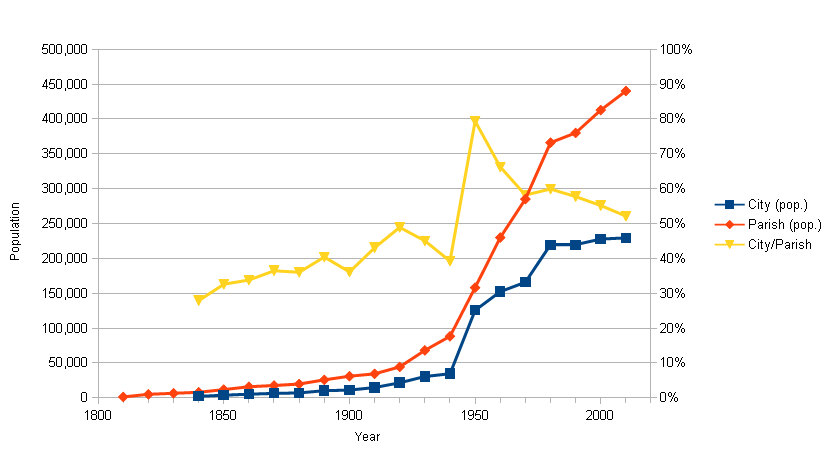
Population of Baton Rouge city and parish, 1810-2010
From what I can tell given the sources available to me, the story begins in 1881 when the city of Baton Rouge had a population of 7200, the parish had a population of 20,000, and there were rumblings of creating a streetcar system. This was during what's now termed the "Long Depression", the time between the Panic of 1873 and the Panic of 1893. So let's start the timeline there.
1881
October 11 — Baton Rouge Street Railway Company charter filed1
November 11 — Baton Rouge Street Railway Company franchise purchased from City of Baton Rouge but fails to produce anything because funds could not be raised 1
1888
November 10 — William Garig (a very rich white guy with a house at 243 Lafayette St.) tried a second time to start a street railway by travelling north to find investors; Baton Rouge Street Railway (BRSR) chartered in Suffolk County, Massachusetts ref ref 1
1889
March 21 — franchise ammended and assigned to J.A. Andrews, J.N. Ogden, and H.W. Ogden 1
? — Baton Rouge Electric Light and Power Company brought electric lights to the city ref
1890
? — Baton Rouge Electric Light and Power Company amended charter to be named Citizens' Electric Light Company ref
October 16 — streetcar started operating 1
October 22 — Baton Rouge Railway & Improvement Company (BRRIC) chartered, planning electrification; took over BRSR 1
1892
September 22 — Capital Railway & Lighting Company (CRLC) chartered in Baton Rouge as subsidiary of Fort Wayne Electric Company with the goal of purchasing BRRIC and Citizens' Electric Light & Power Company ref 1
November 5 — entire property transferred from BRRIC to CRLC 1
November 15 — CRLC absorbed Citizens' Light & Gas Company (indicating how closely tied streetcar and electric service would become) 1
1893
April 6 — electric streetcar service started 1
1895
June 1 — Home Electric Company, a new local company, chartered to purchase CRLC property 1
1900
June 20 — Baton Rouge Electric & Gas Company (BREGC) chartered to purchase all electric, gas, and railway property in Baton Rouge 1
1907
February 14 — Stone & Webster Engineering Corporation, national holding company of railway systems, bought BREGC 1
August 9 — Baton Rouge Electric Company (BRECO) formed by Stone & Webster to take over BREGC 1
1909
January 30 — sale finished of BREGC to BRECO 1
1925
? — BRECO bought 3 buses for service between downtown and LSU, which had moved south of the city 2
later in year — Stone & Webster formed the Engineers Public Service Company to control its public utility operating companies through stock ownership ref
1932
November 9 — city allowed BRECO to replace East Blvd Line with buses 1
1934
early in year — North Baton Rouge Line replaced by 5 buses 1
1935
August 26 — Public Utility Holding Company Act of 1935 passed to regulate electric utility holding companies, effective October 1
? — Stone & Webster "opted to divest itself of its utility holdings" ref
1936
April 23 — City Belt Line ended; only buses in service 1
Things get hazy at this point. Baton Rouge Electric Company was running the city bus system. Its parent company seems to still have been Stone & Webster Engineering Corporation, itself a subsidiary of Stone & Webster. (Interestingly, Stone & Webster was bought by the Shaw Group in 2000.) While Stone & Webster would eventually get out of the picture, they seem to still be in it. What I can't figure out is how the Baton Rouge Bus Company was created.
1938
? — Gulf States Utilities Company merged with BRECO underneath holding company Engineers Public Service Company ref
1942
? — by this year, Engineers Public Service Company controlled the Baton Rouge Bus Company, Inc., but the U.S. Securities and Exchange Commission basically ordered Engineers to divest ref
? — Stone & Webster leave Engineers Public Service Company as the principal holding company ref
Things still hazy. How did stock get sold from Engineers Public Service Company to United Transit Company?
1943
? — Engineers Public Service Company no longer the parent company of Baton Rouge Bus Company; in fact, there is no parent company (uncorroborated) ref
1944
December — United Transit Company of Richmond, VA, owned controlling interest in Baton Rouge Bus Company (uncorroborated) 2
1945
? — United Transit Company bought controlling interest in Baton Rouge Bus Company (uncorroborated) ref
1947
? — under pressure from the SEC, Engineers Public Service dissolves itself; Gulf States Utilities separated to become a free-standing entity (irrelevant to the bus system, but still interesting to know) ref ref
1953
February-June — city-parish council voted to raise fares from 10 to 15 cents on the city's buses, leading to a bus boycott ref
It's not clear to me how the council could vote on fares for a private company. But I suppose this did happen before with the streetcars when the city set the rules on what the franchise could charge. Weird.
1962
March — controlling interest in United Transit Company, parent company of Baton Rouge Bus Company, purchased by American Transportation Enterprise (ATE) of New York 2 ref
1968
November 20 — Keith Lanneau purchased all of the stock from ATE; renamed company Metro Transit Corporation (MTC) ref
1970
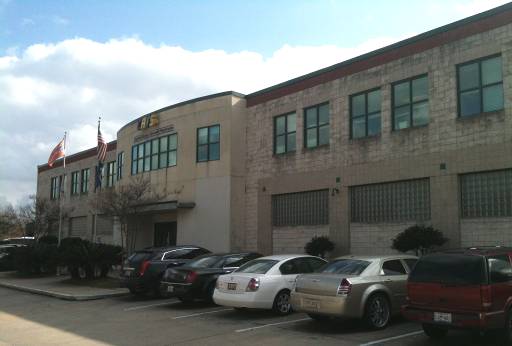
CATS administrative building
late July and early August — City of Baton Rouge created Capitol Transportation Corporation (CTC), a non-profit municipal corporate agency, and bought up eight small interurban bus operations ref
August 21 — City of Baton Rouge purchased MTC and consolidated all the various routes ref
1988
January — Mayor Pat Screen sold $3.5 million of federal grants to Los Angeles/Long Beach for $2 million in order to subsidize CTC after federal and state aid was cut ref ref
April 11 — new transit center opened at N. 22nd St. and Florida Blvd. ref
1992
April — FTA approved a $4.3 million federal grant for CTC to relocate maintenance and administrative offices from 1111 Seneca St. ref
April-May — after incessant complaints about fare increase from 75 cents to $1 and a 7% decrease in route coverage, the CTC board decided to seek additional funds from the Mayor instead ref
May-June — Metro Council first rejected $4.3 million federal grant and later approved it ref
August — Gov. Edwin Edwards agreed to cover CTC deficit for the year ref
1993
January — CTC board and later the Metro Council approved fare rate increase from 75 cents to $1 ref
1996
February — Metro Council approved fare rate increase from $1 to $1.25 amid protests ref ref ref
1998
May 2 — administrative building opens at 2250 Florida Boulevard, next to transit center; construction took nearly 3 years seemingly because original contractor was sentenced for federal tax evasion ref ref ref ref ref ref
May-June — riders protested new route changes; CTC worked with them to tweak routes (may be first time public input is used) ref ref
1999
October — riders experienced service time and route expansion during the 1998-1999 period due to the start of 3 years of increased federal funds [citation needed]; CTC saw surge in passengers since June ref
2000
January — park-and-ride service started; named "Carefree Commute" ref
October 11 — Metro Council approved a contract between the city-parish and CTC, who had gone without a written contract outlining the relationship since 1970, during which time there had only been an informal operating agreement ref
2001
February — large cuts in state funds starting in mid-2000 caused CTC to begin considering cutting service despite an increase in ridership ref ref
July 15 — cost-saving route changes went into effect ref
November 16 — park-and-ride and extra-EBR routes ended due to lack of funds ref
2002
March — it became apparent that one-time federal money can't be used to pay for recurring expenses ref ref
July 24 — the CTC board voted on June 18 to end Sunday bus service starting in August; this decision was reversed by the Metro Council ref
October — 11 of 15 routes get reduced peak-hour service despite Metro Council disapproval ref
November 5 — voters in East Baton Rouge Parish decline a 1.25-mill, 5-year property tax to fund CTC (47% yes, 53% no) ref
2003
April 23 — Metro Council denied CTC's request to hold election on a new sales tax to support bus system; would rather a property tax ref
November — CTC board, initially pushing for a March 9, 2004, 4-mill property tax election (initially a 5-mill, 5-year tax with 1-mill going towards sidewalks and bicycle path improvement), realizes it would cost too much money to get it on the ballot ref
2004
February — Dwight Brashear hired as new CEO of CTC ref
August — CTC buses began getting new purple, yellow, and blue paint job ref ref
October — CTC renamed to Capital Area Transit System (CATS) ref
2005
January — CATS board approved new dedicated bus route between Baton Rouge Community College main campus and its satellite campus ref
August 10 — Metro Council approved giving $600,000 of $1 million dollar budget gap to CATS to offset increased cost of diesel fuel and told to expect request for fare increase and route adjustment ref
August 16 - CATS board approved fare increase and cutting routes to save $400,000 ref
August 24 - Metro Council rejected changes to fares and routes and will try to find the money in city-parish budget ref
August 29 — Hurricane Katrina displaced an estimated 100,000 people into Baton Rouge, causing CATS to phase in additional buses and to find additional funding ref ref ref
November 9 — Metro Council voted to shift $400,000 from city-parish general fund to CATS ref
November 22 — Metro Council approved CATS board's request to raise bus fare from $1.25 to $1.75 ref
2006
late August — CATS scrapped plan to include 8.5-mill, 20-year property tax on the September 30 ballot after Mayor Holden and BRAC president publicly opposed sending the issue to voters ref
October 2 — CATS CEO Dwight Brashear resigned ref
November 30 — FEMA ended funding of expanded post-Katrina bus routes in Baton Rouge ref
2008
January 9 — Metro Council rejects CATS board's request to cut 6 of its 17 routes ref
January 27 — CATS board goes ahead with reducing service on 6 routes to fill projected $183,000 shortfall in $16 million budget ref
2009
August 1 — Tiger Trails, run by Ohio-based First Transit, took over LSU's campus transit from CATS, charging LSU $3.5 million while CATS was only charging $2.4 million ref ref
November 24 — Brian Marshall hired as new CEO of CATS ref
November 24 — Metro Council rejects request to raise fares and change some routes ref
December 16 — Metro Council approved raising fares for disabled users, combining some routes, and trimming nighttime transit service hours ref
2010
January 26 — start of 18-month initiative to create comprehensive plan, FUTUREBR
October 2 — voters in East Baton Rouge Parish decline a 3.5-mill, 12-year property tax to fund CATS (47% yes, 53% no) ref
2011
January 5 — CATS board approved fare increases, route-cutting, and weekend service elimination
January 12 — Metro Council rejected changes
June 8 — Blue Ribbon Commission recommended quarter-cent sales tax, 4-mill property tax, and East Baton Rouge Parish transit taxing district ref
July 20 — private donation from East Baton Rouge Mortgage Finance Authority helped CATS fill one third of its $1.5 million budget hole ref
July 26 — Louisiana Office of Community Development gave $500,000 in federal block grant funds; remaining deficit said to come from other federal grants ref
| Date | Fare ($) | Duration (yr) |
|---|---|---|
| 1881 | 0.10 | 72 |
| 1953 | 0.15 | ? |
| ? | 0.75 | ? |
| 1993 Jan | 1.00 | 3.1 |
| 1996 Mar | 1.25 | 9.7 |
| 2005 Nov | 1.75 | 20.9 |
2012
April 21 — voters in Baton Rouge and Baker approved a 10.6-mill, 10-year property tax to fund CATS (Baton Rouge: 54% yes, 46% no; Baker: 58% yes, 42% no); Zachary voters declined the tax (21% yes, 79% no); tax projected to bring in $16.6 million from Baton Rouge and $636,000 from Baker, raising budget to about $30 million; an additional $1.1 million would have come from Zachary ref ref
April 25 — CATS Board approved GPS system contract to RouteMatch, an Atlanta transit technology firm, for about $1.4 million ref
May 30 — independent auditor estimated $14,893,935 to be "reasonably expected" from Baton Rouge tax and $424,858 from Baker tax, totaling $15.3 million ref
May 30 — Attorney General of LA James "Buddy" Caldwell issued opinion that property tax qualifies for homestead exemption, removing $3 million per year from CATS's future budget; since property values were reassessed statewide for 2012, this is only a $1.2 million decrease from the property tax (from $17.2 million to $16 million) ref
June 8 — Governor Jindal vetoed state legislation that would have removed the Metro Council as the authority over approval of changes to fares, routes, and schedules ref ref
Oct 18 — city-parish general fund and parish transportation fund revenue withdrawn for a total of $3.6 million for the coming year (city-parish gave $2,949,250 in 2011 and $2,949,330 in 2012); this lowers the projected budget from $30 million (projected circa April) to $24.8 million, which is 82.7% of the projected budget ref ref
Dec 18 — CATS Board of Commissioners approved $17.7 million budget for 2013 (news report maintained estimate of $15.3 million from new property tax) ref
2013
January — GPS installed on 79 vehicles (59 buses and 20 paratransit vehicles); RouteMatch to provide its own mobile phone app (data not yet open for independent app development); system will cost about $15,000 a year in operational costs; digital signs on buses and at the terminal are among the improvements ref ref ref
April 22 — CATS CEO Brian Marshall resigned ref
CATS Finances
I don't pretend to fully understand business financial reports. I get the basics of revenue and expenses, of course. What I don't get is how assets and capital contributions play into a budget.
| 2008 | 2009 | 2010 | 2011 | 2012 | 2013 | |
|---|---|---|---|---|---|---|
| Net Operating | -668,127 | -1,622,703 | -1,745,183 | -1,944,260 | 597,517 | 770,912 |
| Total Direct Operating Expenses | -15,985,004 | -15,289,630 | -14,532,091 | -14,316,873 | -13,794,198 | -16,923,068 |
| Total Operating Revenue | 4,754,396 | 3,363,752 | 2,113,474 | 2,117,316 | 2,111,099 | 2,098,625 |
| Total Non-operating Revenue | 10,562,481 | 10,303,175 | 10,673,434 | 10,255,297 | 12,280,616 | 15,595,355 |
2012 and 2013 are projections from 2012 Dec 18 Board meeting
Sources: CATS Annual Financial Statements
(2009,
2010,
2011),
Operating & Property Tax Fund Budget Reports (Dec 18, 2012)
- "Direct Operating Expenses" is made up of "Operating Expenses" and "Depreciation Expense".
- "Operating Revenue" is made up of "Charges for Service" (rider fares, contracted fare services) and "Advertising Revenue".
- "Non-operating Revenue (Expenses)" is made up of "Interest Income", "Interest Expense", "Other Expenses", "Loss on Disposal of Fixed Assets", "Government Operating Grants", "Hotel/Motel Tax", "Other Revenue", and "Operating Transfers from Primary Government".
- "The City-Parish owns the [bus] terminal, administrative office building, and related land which are used by [CATS] for its operations. The City-Parish provides these facilities and land to the System at no charge through an operating agreement." ref
In Summary
One thing I've learned from all of this research is that utility and street railway companies were bought very frequently before 1910. I'm not sure if it's coincidence, but around that time, holding companies got very popular. It was very common for the nation's urban streetcar companies to be owned by a holding company off in some other state. And quite often the streetcar company was very closely tied to an electric utility company. The reason is financial: I don't understand it, but the regulated utility company could sell electricity to the streetcar company in an unregulated way, somehow ripping off consumers in the process. That's why the Public Utility Holding Company Act of 1935 was created. At that time, streetcar operating companies were dropped left and right and bought up by other private companies to be dismantled. Baton Rouge was just one of many cities affected by all this mess.
As for how the long line of private businesses ended up as a government-run affair, that is also pretty common. By the '60s and '70s, buses just weren't making a profit anymore. People loved their cars and the suburbs were expanding considerably. No bus routes could possibly compete with suburban driving. I guess city governments felt they had to take care of their poorer citizens, so they bought the bus companies. With tax-payer assistance, they were able to hobble along without going out of existence.
Baton Rouge shares a similar history of its transit system with other cities, but I don't know if Baton Rouge diverges with its recent dismal transit funding. From what I've read so far, Baton Rouge is still a good bit behind other comparable cities on how to properly fund and design its transit system. The 2012 property tax certainly helps with creating a dedicated source of funding, but it still doesn't provide CATS with a budget that's large enough to support the potential of the city.
But I won't complain too much because the important piece is having dedicated funding. During the 1998 to mid-2000 period, CATS ridership increased because services could be expanded thanks to combined federal, state, and city-parish funding. The funding was non-recurring, so as that went away, so did the ridership. After that, the system was again stuck in a perpetual cycle of budget shortfalls and fights with the Metro Council about raising fares and cutting service. It was only with the 2011 budget that completely ending the bus system was ever threatened. First they said October 2011. Then as the year went on and diesel prices jumped higher, they said July. Money was scrounged up, but 2012 was looking to have an even larger budget deficit.
Something else I've marginally researched: does any city have a private company running its transit system? Well, let's look at the New Orleans Regional Transit Authority (NORTA or just RTA). Its history is somewhat similar to Baton Rouge: New Orleans Public Service, Inc. (NOPSI), a private electric and natural gas utility and mass transit provider, consolidated several competing streetcar lines in 1922; NOPSI converted the streetcar lines to buses in the '50s and '60s (except the St. Charles Line); and then in 1983, NORTA (a public entity created by the State in 1979) took control of the transit system due to lack of profitability. Besides having a streetcar line run the entire time since 1835 (thanks to preservationists in 1973 listing the St. Charles Line on the National Register of Historic Places), New Orleans transit differs in their management: Veolia Transportation (a giant international company) now manages and operates the system under contract to the RTA Board of Commissioners. How well this private-public partnership works, I don't know. But this Business Report article on the situation addresses the question of paying more for a private company and getting increased efficiency.
The above time line is mostly accurate. I still think there are some short-lived companies that are missing, such as the Baton Rouge Electric Light and Power Company from 1889 or so until some other time. It's pretty hard to keep straight which are the utility companies and which are the transit companies. I'm also missing some sources that could tell me when some companies began, such as the Baton Rouge Bus Company. I just guessed on that one.
Then there are all the rich white guys. I haven't even really gotten into them simply because there are so many of them. They hop around from company to company as owner or president or board member, affecting policy and making decisions that affect everyone else. For example, Benjamin Raphael Mayer could be on the time line from around 1891 until 1900. He was involved with Baton Rouge Electric Light and Power Company, Capital Railway & Lighting Company, and Home Electric Company. He was president for each one at some point. But before all that, he was owner of Baton Rouge & Western Transportation Company. The network must have been small back then because these guys got around.
Non-web References
- Hennick, Louis C. and E. Harper Charlton. Louisiana: Its Street and Interurban Railways. Ed. Louis C. Hennick. Vol. 1. Shreveport, LA: 1962.
- "History of Transportation in Baton Rouge." Capitol Transportation Corporation, circa 1983-1990. Microsoft Word file.


